

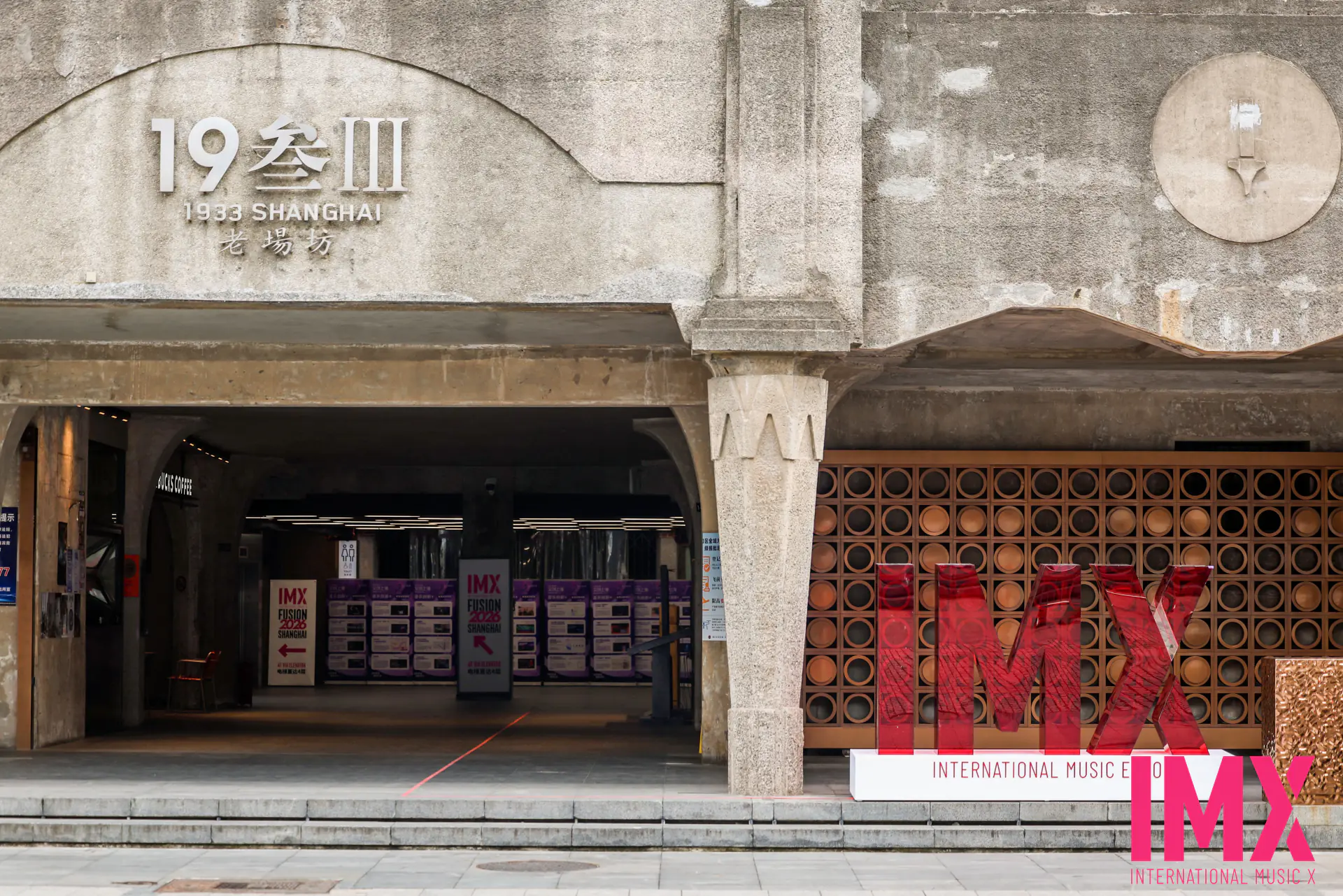
IMX 2026 Shanghai Day 1 Recap: Industry Foundations, Global Corridors, and What Remains Scarce in the AI Era
From the historic concrete arches of 1933 Shanghai, IMX 2026 opened its three-day flagship summit exploring how the global music business reorganizes itself when content approaches infinity — featuring cross-border market routes, AI rights attribution, indigenous acoustic preservation, and the launch of the International Music Alliance.
Inside the historic concrete corridors and soaring art-deco arches of 1933 Shanghai, International Music X (IMX) officially opened its 2026 Shanghai summit on Thursday, October 29. Marking its sixth year as Asia's premier cross-border music industry bridge, IMX 2026 convened hundreds of label founders, DSP leaders, rights specialists, artists, and music-tech innovators under a decisive opening day theme: Industry Foundations — How the global music business is reorganizing itself, and what holds its value once content stops being scarce.
Opening Ceremony: From Global Connectivity to Concrete Integration
The morning began with an energetic robotic performance highlighting the accelerating pace of machine intelligence, followed by welcoming remarks from civic cultural representatives and IMX leadership.
Xiaoman Zou, Co-Founder and COO of Kanjian Music, set the strategic direction for the summit: "Over the past six years, IMX has evolved from a forum for exchanging perspectives into an active cross-border execution engine. We have tackled creation, distribution, streaming, copyright commercialization, and cultural collaboration. Today, as technology reshapes production and regional markets shift, our focus is no longer just talking about connectivity — it is achieving concrete industry integration."
The opening session also hosted the official launch of the 2026 Shanghai Cultural & Creative Innovation and Entrepreneurship Competition (Music Track), presented by Qiang Ying (Chairman, Hongkou District Cultural and Creative Industries Promotion Association) and Sun Lei (CEO, Migu Music), cementing Shanghai's commitment to music technology and copyright innovation.

World Music Seeds: If Music Never Makes It into the Data, Will It Disappear?
The morning program transitioned into the World Music Seeds strand, beginning with the Annual Case Awards presented by Sun Lei (Migu Music) and Shen Jia (Founder & Chairman, Kanjian Music). The awards honored groundbreaking preservation and cross-cultural initiatives, including the Homeland Project's Southern Shaanxi Echoes series and Qiang traditional heritage projects.

Rather than opening with presentation slides, Li Jie (Chairman, Beijing Dongfangle Culture Communication) opened with pure sound: unmediated acoustic field recordings and live vocal resonance from Southern Shaanxi folk traditions, allowing delegates to experience the uncompressed emotional weight of indigenous sound.
This grounded an urgent keynote by Zhu Fangqiong, founder of Unintended MUSiC Studio: "If a genre of music never makes it into the data, will it disappear from the AI era?" Zhu confronted the existential challenge facing traditional, acoustic, and orally transmitted musical heritages: in a world where AI foundational models are trained strictly on standardized digital datasets, unannotated and analog traditional sounds risk being permanently excluded from the collective machine memory of future generations.
The ensuing roundtable — featuring Liu Chang (Beijing Hualu New Media), Liu Pengfei (China Record Group), Li Jie, and Rui Wenbin (Xingwaixing Music Group) — explored actionable methods to balance modern digital distribution and AI training with the preservation of cultural authenticity ("原真性"), ensuring ancestral musical roots find sustainable commercial and educational life across global platforms.
Going Global from the Edges: Building Corridors Outside Legacy Centers
Growth in the modern music business is increasingly originating outside traditional Anglo-American capitals. In a standout mid-morning roundtable moderated by Rita Gimenez (Founder, Dynamic Public Diplomacy; Executive Director, Music Tech Hub), international operators dissected what it takes to build lasting trade routes across regions.
Oleg Troyanovsky, Head of Music at Animotion Media Group, shared how independent animation IP and creator-led music from Eastern Europe systematically conquered global YouTube audiences, emphasizing that deep local adaptation and direct engagement with regional creator communities matter far more than blanket distribution. Raul Rodrigues (CEO, Upbeat Studio; Board Member, Music Tech Hub) detailed the educational music-tech bridge between Brazil and Europe, outlining how independent music software tools can scale globally by solving specific technical hurdles for instrumentalists and creators.
The panel agreed: long-term cross-border expansion cannot rely on one-off licensing deals. It requires institutional bridges, localized language adaptation, and continuous bilateral presence.


Midday Spotlight: Expressive Boundaries in Cross-Regional Creation
During the midday music chat, Chengdu-based singer-songwriter and producer Jody Jirong performed excerpts from his album Is it gonna happen again?, followed by an intimate discussion on modern distributed creation. Jody illustrated how bedroom production and remote collaboration across different cities and time zones allow creators to transcend geographic isolation, dismantle rigid genre classifications, and translate personal vulnerability into music that resonates across borders.
Redefining Rights: Training Data, Performance, and Attribution in the AI Era
The afternoon opened with a critical legal and institutional roundtable addressing the convergence of generative models and copyright administration. Moderated with precision, the session united Guo Kun (Deputy Secretary-General, China Audio-Video Copyright Association - CAVCA), Carol Li Wei (Vice President, NetEase Cloud Music), and Liu Jiadi (Partner, Jun He Law Offices).
The panel confronted the reality of modern production: when a finished work combines human performance, model prompts, training weights, and stem manipulation, how should rights be unbundled and remunerated? Guo Kun outlined CAVCA's focus on upholding human creative authorship while establishing collective management frameworks capable of tracking and licensing recording contributions. NetEase Cloud Music's Carol Li Wei highlighted platform responsibilities in distinguishing between fully synthetic outputs and human-assisted compositions, while Jun He's Liu Jiadi provided legal clarity on fair compensation models for rightsholders whose catalogs are utilized to train commercial models.
When Content Approaches Infinity, What Becomes Truly Scarce?
In one of Day 1's most anticipated and heavily attended discussions, industry veterans and creators debated the valuation of music when generative tools drive track supply toward infinity. Panelists included singer-songwriter and musical theater artist Su Shiding, independent A&R consultant Hu Yiqun, Ji Shengshan (Co-Founder, Xiangxu Technology / Yixian Entertainment), and Du Mingxuan (Founder, Y3X MUSIC).
The consensus was decisive: when audio content becomes commoditized and infinite, value migrates from raw sound files to human context, authentic stage presence, fan intimacy, and unrepeatable emotional vulnerability.
Su Shiding offered the day's most memorable perspective, describing herself as an unapologetic "hand-crafted musician" (手搓型音乐人): "AI can generate endless melodies and simulate production, but it cannot replicate the unrepeatable electricity between a singer and an audience on a live stage. A human performance carries the singer's scars, life choices, and physical vulnerability — that is where the 'taste of humanity' (人味) lives. That genuine human spirit is what will always remain irreplaceable and scarce."

The New Eurasian Renaissance & The International Music Alliance
A major institutional milestone was achieved in the late afternoon with the official signing ceremony expanding the International Music Alliance, led by Kanjian Music's Xiaoman Zou and Olga Demina (Executive Director, CIS and Eastern European Markets, Daflow.ai). The alliance establishes a dedicated B2B trade corridor connecting East Asia, Central Asia, and Eastern Europe, setting the foundation for the upcoming IMX Almaty circuit.
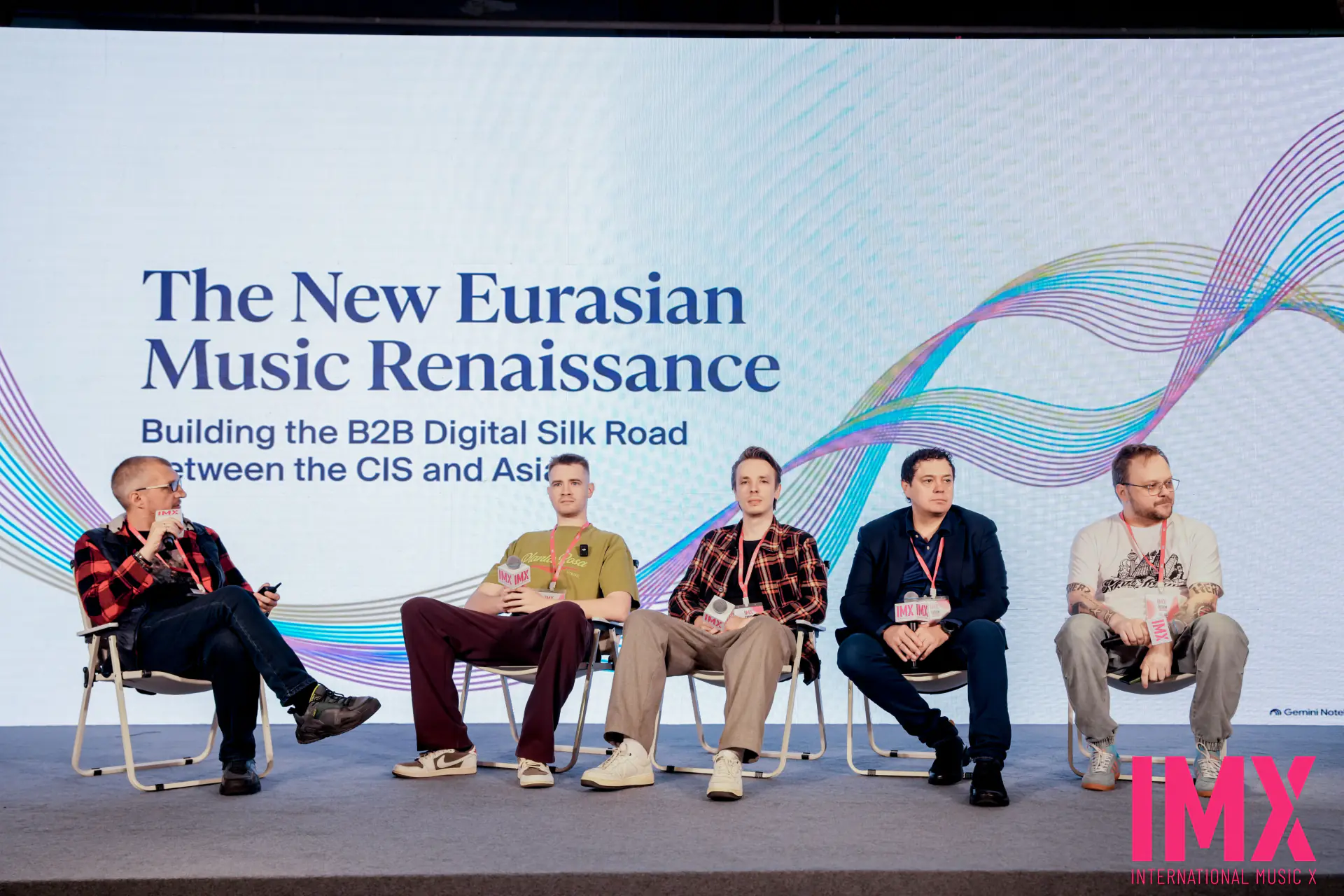
This was followed by an in-depth roundtable titled The Russian and CIS Music Market: Platforms, Technology, and a Two-Way Content Bridge with Asia, featuring Vlad Yankovsky (Founder, SFEROOM), Anton Diachenko (Founder & CEO, MMG; Organizer, NAMI Festival), Mikhail Kryukov (CEO, SFEROOM), and Dmitry Yankovenko (Moscow Music Dome). The speakers mapped out what they coined the "B2B Digital Silk Road," analyzing platform distribution dynamics, high-growth streaming markets across Kazakhstan, Uzbekistan, and Russia, and concrete frameworks for licensing Asian catalogs into Eurasian DSPs while touring Eurasian acts across East Asia.

Platform Governance & The Post-Streaming Horizon
As the afternoon drew to a close, a specialized platform panel featuring Kevin Liu Guangtao (COO, Image Music Group), Yu Lan (Head of Music Center, Kuaishou), Yu Zuyi (Founder & CEO, Changsha Shensheng Buxi Culture), and label founder Wen Zhen examined how short-video and streaming platforms must govern AI-generated uploads. The panel emphasized transparent labeling, algorithmic quality filtering, and fraud suppression to safeguard listener trust and ensure legitimate human creators are properly compensated.
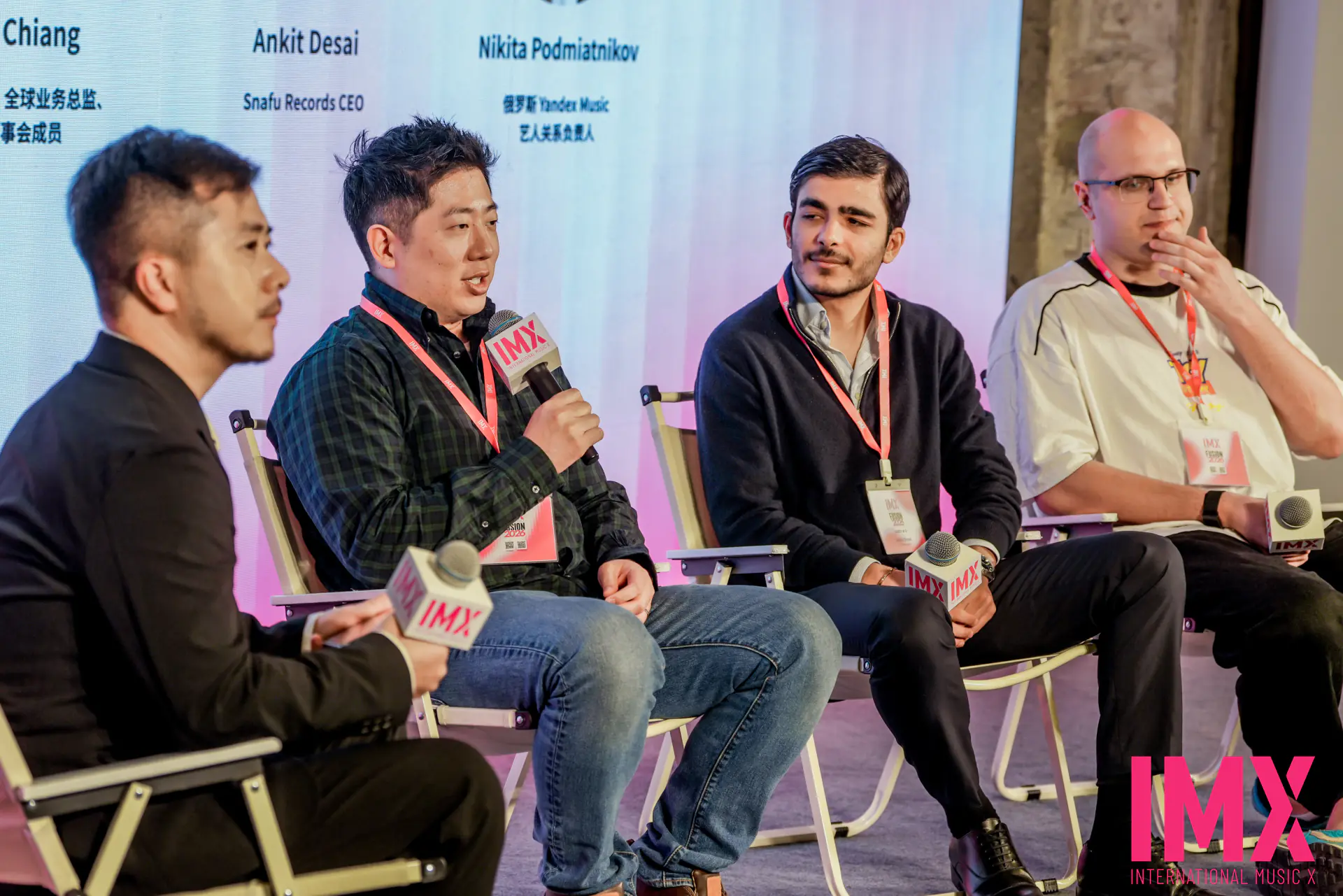
The day culminated in a forward-looking panel moderated by Benson Zhang (Chapter 2 Entertainment): After Streaming: Who Will Create the Music Industry's Next Wave of Growth?
Jeffrey Chiang (Global Business Director, Fluxus; Board Member, Merlin), Ankit Desai (CEO, Snafu Records), and Nikita Podmiatnikov (Artist Relations Lead, Yandex Music) tackled the structural challenges of plateauing streaming subscriptions in mature markets. Jeffrey Chiang highlighted the vital role of collective independent rights organizations like Merlin in securing fair value share from emerging tech platforms. Ankit Desai demonstrated how data-driven A&R combined with algorithmic curation can identify untapped artist momentum early, while Nikita Podmiatnikov showcased how hybrid subscription bundles and local artist development are unlocking massive growth across Central Asia and the CIS.
Looking Ahead to Day 2: The AI Frontier
Day 1 proved that even in an era of rapid technological disruption, the foundation of the music industry remains human connection, rigorous rights infrastructure, and cross-cultural solidarity.
The summit continues on Friday, October 30, with Day 2 focusing on Artificial Intelligence, featuring the two-hour AI Music Lab Product Showcase, in-depth workshops on generative audio ethics, global synchronization forums, and the highly anticipated bilateral B2B matching sessions.
Stay tuned to imxgo.com for daily updates, full session recordings, and key takeaways from IMX 2026 Shanghai.
Other Articles

IMX Reschedules Seoul Edition to 2027 and Rallies Global Network in Full Support of the Seoul Music Forum

IMX 2026 Announces the Second Confirmed Speakers
IMX 2026 Announces the First Confirmed Speakers
IMX Unites IMCJ, LIAK, SIMCA & A2IM For APAC AI-Ready Music Monetization Summit

IMX 2026 Sponsorship Opportunities: The Global Advantage

One Trip, Three Markets: The Shanghai-Seoul-Tokyo Circuit

IMX Seoul Announces Co-Hosting With LIAK And IMFS

Announcing IMX Almaty And IMX İstanbul 2026 Co-Hosts

IMX 2026 Spotlights AI, Rights Tech & Web3 Music Innovation

Trade Missions Open: Connecting European & American Delegations to APAC

Open Call for International Artist Showcases across 5 Circuit Cities
